You can have a polished resume, a clean LinkedIn profile, and years of experience, then still watch your applications vanish. That usually happens when your skills and abilities are listed like a souvenir collection instead of a hiring signal. Employers read for proof, not history, and the strongest candidates translate what they can do into the exact language a role asks for.
Why Skills Matter More Than Job Titles Now
Plenty of job seekers still apply the old way. They trust title, tenure, and a clean timeline to carry the story, then wonder why a recruiter moves on after a quick scan. Experience still matters, but it has to be readable as role-matched skills before anyone digs deeper.
The first screen is mechanical. Keyword filters and skills-based scoring do the first pass, so your resume has to show competence in a way software can read and a recruiter can trust. A candidate with clear, job-shaped evidence often beats someone with a broader background but weaker alignment.
The World Economic Forum's Future of Jobs Report 2025 puts analytical thinking at the top of the skills employers want, with roughly 7 in 10 companies calling it essential. Resilience, flexibility and agility follow at 67%, leadership and social influence at 61%, and creative thinking at 57%. AI and big data are projected to be the fastest-growing skills through 2030, and employers expect 39% of workers' core skills to change by then.
A resume works like a translation layer. "Project management" is too broad to mean much in a software, data, or product role. "Ran sprint planning for a cross-functional product launch," "built SQL queries to track funnel drop-off," or "shipped a Python script that cut manual reporting" makes the same underlying skill visible in job-specific language. That is the version a recruiter can match to a posting, and screening software can read as evidence instead of a label.
If your applications are going quiet, the wording is often the culprit rather than the experience. We covered the other common causes in why your resume isn't getting responses.
Hard Skills and Soft Skills, With Real Examples
These two get mixed together so often that job seekers end up with lists that do little for hiring. Employers read them differently. Some skills can be checked in a test or work sample. Others show up in how you explain a decision, work through conflict, or keep a project moving when the details change.
Hard skills are teachable, measurable, and usually tied to a tool or method: Python, SQL, financial modeling, Figma wireframing, A/B testing, Tableau dashboards. Soft skills are the cognitive and interpersonal abilities that hold the technical work together: communication, adaptability, problem solving, stakeholder management. The U.S. Bureau of Labor Statistics organizes its skills data around occupation-level groups like critical and analytical thinking, computers and information technology, problem solving and decision making, project management, and writing and reading.
Hard skills are the ingredients. Soft skills are the technique, timing, and judgment that decide whether the same ingredients become a good loaf or a dense one. Two candidates can both list SQL. The one who also explains findings to non-technical stakeholders, prioritizes well, and spots edge cases is the stronger fit. The tool gets attention. The way you use it creates the value.
Quick test: If a skill can be checked in a short assignment or benchmark, it is a hard skill. If it changes how well you collaborate, decide, or adapt, it is a soft skill.
| Dimension | Hard skills | Soft skills |
|---|---|---|
| What they are | Specific, teachable competencies | Interpersonal and cognitive abilities |
| How they show up | Tools, systems, methods, frameworks | Communication, judgment, collaboration |
| How employers check them | Tests, portfolios, work samples, technical interviews | Behavioral interviews, references, outcomes |
| Example for software | Python scripting | Cross-functional collaboration |
| Example for data | SQL querying | Stakeholder communication |
| Example for product | Roadmap planning | Influence without authority |
Hiring managers usually want both, because the best technical work still has to be explained, coordinated, and delivered.
How to Identify Your Own Skills
Most people undercount their skills because they only remember the obvious ones. They remember the project they led, but not the negotiation that made it possible. They remember shipping a feature, but not the debugging pattern that saved the sprint. A good self-audit pulls both into view.
Start with recent work, not job titles
Write down the tasks, projects, and deliverables you handled in the last 12 to 24 months. Do not summarize your job as "software engineer" or "data analyst." Break it into things you actually did: built a reporting dashboard, cleaned a pipeline, wrote acceptance criteria, ran a stakeholder review. That gives you raw material instead of a vague identity label.
Translate each task into the skill underneath
A dashboard project points to data visualization and information design. A sprint planning role points to prioritization and project coordination. A customer escalation points to conflict resolution and executive communication. The more specific the translation, the easier it is to match your background to a posting later.
Attach evidence to each skill
A skill becomes credible when you can point to a result. Maybe you cut manual steps, helped a team respond faster, or supported a launch that reached more users. You do not need a number on every bullet, but you do need a concrete outcome. Describing what changed because of your work moves you from "I know this" to "I have used this."
Use outside feedback to catch blind spots
Managers, peers, and performance reviews surface strengths you have normalized. Maybe people rely on you to untangle messy requirements or make technical work understandable. Those comments matter because they show which abilities are visible from the outside, not just felt on the inside.
Keep the result as a living skills inventory. Once you have it, you can sort it against real job descriptions instead of guessing from memory.
The Skill Clusters Employers Screen For
A software candidate who can write code but cannot explain trade-offs, or a product candidate who can talk strategy but cannot turn it into measurable work, usually misses. Hiring teams look for combinations, which is why it helps to think in clusters rather than a long list of unrelated traits.
The OECD's work on skills mismatch explains the gap behind the gap: skills are often present in someone's background, just not in the form a specific role needs. That is how the same person looks strong on paper and still misses a screen.
Five clusters keep showing up:
- Analytical thinking and problem solving. Teams want people who can reason through messy inputs.
- Technical and data fluency. Even non-technical roles now sit near data, code, or automation.
- Execution and project management. Ideas only count when the work lands.
- Communication and influence. Cross-functional work depends on clarity.
- Adaptability and learning speed. Tools and workflows keep changing.
A data analyst who can prompt models, check the outputs, and explain the trade-offs reads as more current than someone who only lists dashboards. A product manager who can write SQL, shape a metric question, and align engineering and design is easier to place on a team.
| Cluster | Example skills | What proof looks like |
|---|---|---|
| Analytical and problem solving | Critical thinking, data interpretation, root cause analysis | A decision you made from ambiguous data, and what it changed |
| Technical and data fluency | SQL, Python, AI tooling, data pipelines | A query, script, or model you shipped and who used it |
| Execution and coordination | Project management, prioritization, follow-through | A launch you moved from plan to delivery, and the timeline |
| Communication and influence | Writing, stakeholder alignment, presentations | A memo or review that changed what a team did next |
| Adaptability and learning speed | Picking up new tools, working through change | A tool you learned on the job and applied within weeks |
The practical move is to translate generic strengths into the language employers use. A "good communicator" becomes someone who writes a clear decision memo or aligns a sprint handoff. A "problem solver" becomes someone who isolates a bug or resolves a product conflict without extra coaching. You can browse live openings by skill on our skills pages to see how employers phrase the same requirement across postings. If you are weighing which technical skills to invest in next, our analysis of the highest-paying programming languages and skills breaks it down by salary data.
How the Mix Changes by Role and Level
People ask for "the skills list" for a role, but seniority changes the mix. A junior candidate is hired for reliable execution. A senior candidate is hired for judgment, scope, and the ability to help others move faster. The same job title can hide very different expectations.
A junior software engineer needs Python, Git, unit testing, and the ability to ship small tasks cleanly. A senior engineer needs those too, but the bar expands into system design, mentorship, cost awareness, and architecture decisions that affect more than one team. The job stops being about writing code and starts being about how code behaves at scale.
Data roles split the same way. An analyst leans on SQL, visualization, and stakeholder communication. A data scientist needs modeling, experimentation, and operational awareness around deployment and monitoring. The deeper the role, the less it is about producing outputs and the more it is about choosing the right problem and defending the method.
Product management follows the pattern. Junior PM work centers on discovery, metrics, backlog triage, and coordination. Senior PMs handle strategy, influence across the org, and decisions that shape how teams are structured. One role proves you can keep the machine moving. The other proves you can decide what machine should exist.
If you are early in your career, do not try to disguise the gap. Translate what you do have into adjacent proof. Project coordination, research, customer empathy, writing, and tool fluency all map to real openings when you show how they were used. Recruiters see a lot of new grads performing seniority. They respond better to learning speed and a concrete contribution.
| Role | Junior-level skills | Senior-level skills |
|---|---|---|
| Software engineering | Python, Git, unit testing | System design, mentorship, cost optimization |
| Data analytics | SQL, dashboards, stakeholder updates | Experiment design, data strategy, cross-team influence |
| Product management | Discovery support, metrics tracking, backlog coordination | Product strategy, organizational alignment, roadmap ownership |
| Early-career generalist | Research, project coordination, communication | Portfolio ownership, initiative, problem framing |
Useful filter: Match your skill bundle to the job level, not just the title. Junior roles reward reliable delivery. Senior roles reward leverage and judgment.
Listing Skills on Your Resume and LinkedIn
Your resume and profile should work as one system. If they say different things, you create noise for both recruiters and search. The fix is to start from the job description and mirror its wording where it genuinely fits.
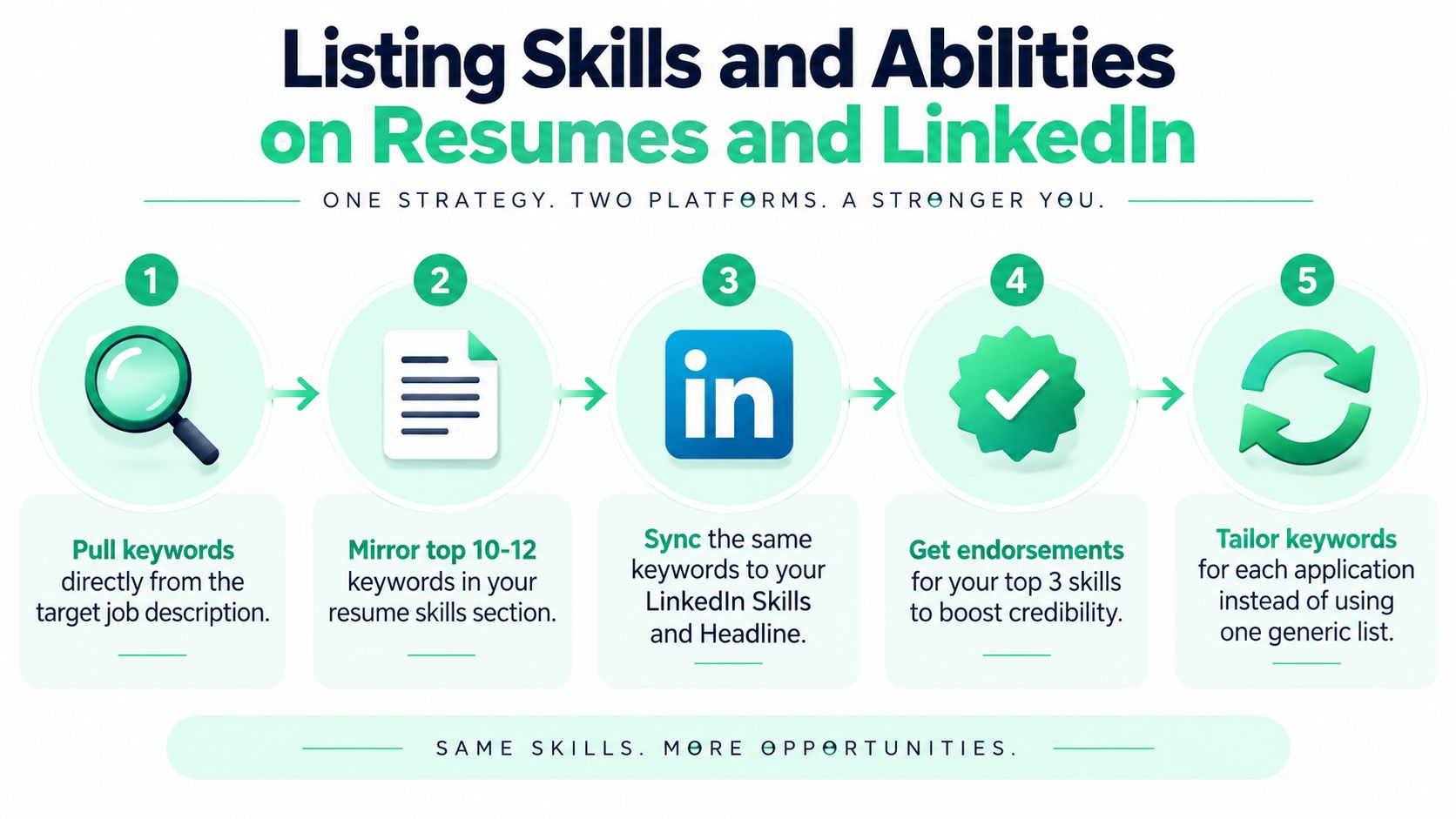
Do not invent new phrasing. Pull the exact terms employers use, then show where you have used them. If a posting asks for SQL, stakeholder management, and A/B testing, those words belong in your skills section, your bullet points, and the matching parts of your profile.
Where the language belongs
Keep a dedicated skills section on your resume, but do not lean on it alone. Your bullets carry the proof, because a list without context looks hollow. On LinkedIn, use the Skills panel, your headline, your About section, and your Experience entries to reinforce the same themes. The goal is repetition with evidence, not keyword stuffing.
"Improved performance" is weak because it does not say what changed. "Reduced p99 latency through query optimization" or "cut onboarding drop-off by removing duplicate steps" names the action and the result. Recruiters understand it, and parsers can match it.
Practical rule: Pull keywords from three to five target descriptions, not one. If the same skill keeps appearing, it belongs near the top.
Common mistakes
Do not paste your LinkedIn skills list straight into your resume. Do not keep tools you have not touched in years. Do not build a wall of synonyms that looks impressive and says nothing. Tailor the language per application and keep the underlying inventory current so edits take minutes instead of hours. If you want that tailoring handled for you, our AI resume tailoring matches your resume against a specific posting.
What People Get Wrong About Skills Sections
The biggest myth is that more skills mean a stronger application. In practice, volume makes a resume noisier. A long list of generic skills hides the few abilities that match the role.
One mistake is listing every tool you have ever touched. Another is copying a posting so closely that the resume reads like a mirror with no substance. Screening tools look for relevance, and recruiters spot forced repetition quickly.
Soft skills get treated as decorative filler. "Team player" and "hard worker" say nothing about what you did. "Led a six-person cross-functional team that shipped a feature ahead of schedule" describes the same trait with context, scale, and an outcome.
The last problem is staleness. If your skills section still centers on tools you no longer use, you are signaling that your working set has not kept up.
Bottom line: Relevance beats raw count every time.
Putting It Into Practice
The cleanest process is a loop, not a one-time rewrite. Audit, attach evidence, then tailor the top cluster to every posting you care about.
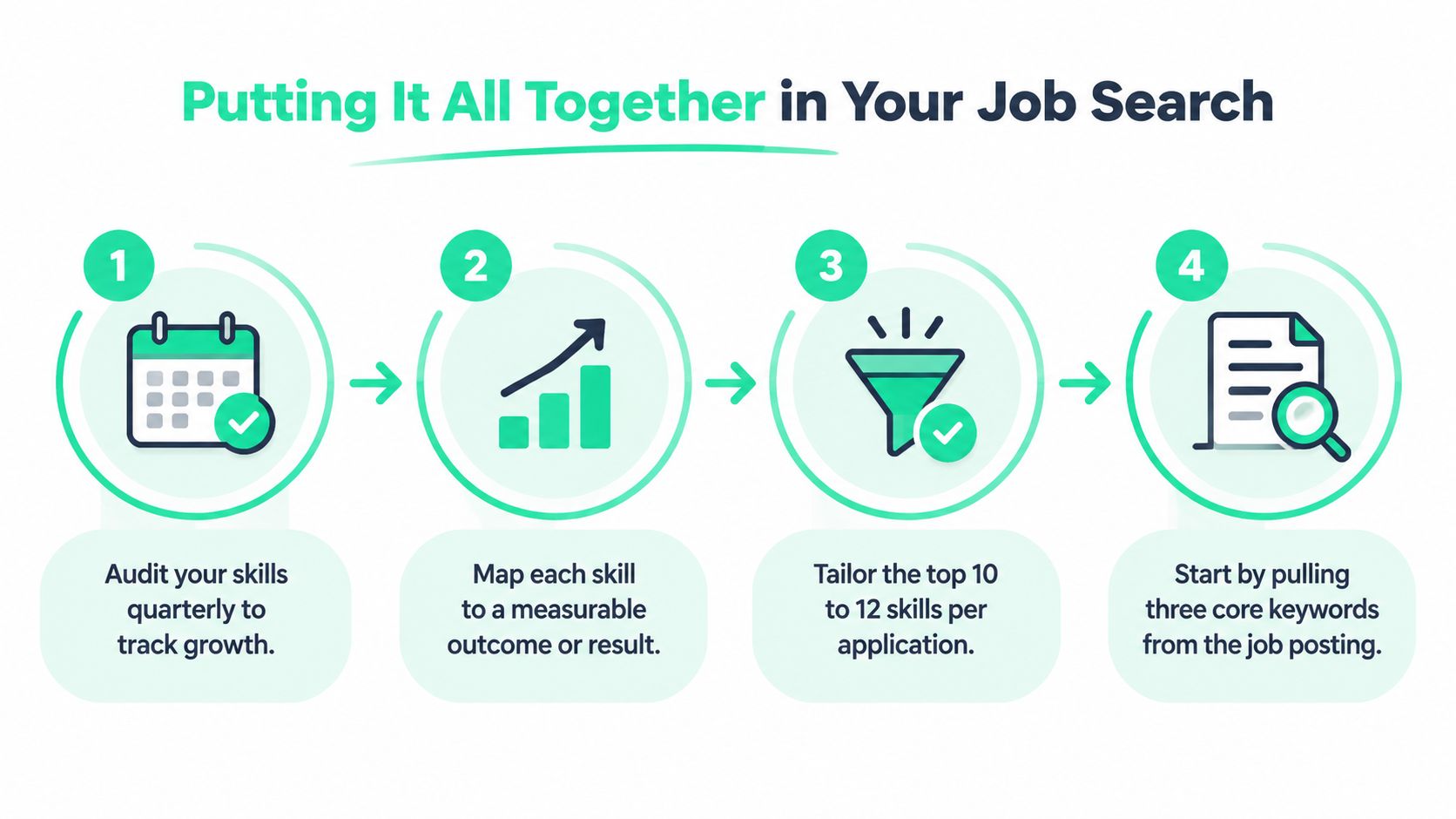
- Pull three to five recent job descriptions and highlight the repeated terms. Repetition is the market signal, not what one manager wrote on one day.
- Audit quarterly. Add new tools, projects, and wins to a living document.
- Map each skill to a result so the proof stays close and updates stay easy.
- Tailor the top 10 to 12 skills per application. Never recycle one static list.
Your resume and profile should read as two versions of the same story. If one says "data visualization" and the other says "dashboards," that is fine when both are accurate. A mismatch in priorities is what weakens both.
The job search gets faster when your language is already organized. Build the inventory once, keep it current, and use it as the source file for every application you send.
Frequently Asked Questions
What is the difference between hard skills and soft skills?
Hard skills are teachable and measurable, usually tied to a tool or method: Python, SQL, financial modeling, Figma, A/B testing. Soft skills are the cognitive and interpersonal abilities that hold the technical work together: communication, adaptability, problem solving, stakeholder management. A quick test: if a skill can be checked in a short assignment or benchmark, it is a hard skill. If it changes how well you collaborate, decide, or adapt, it is a soft skill.
How many skills should I list on my resume?
Roughly 10 to 12, tailored to the specific posting. Volume works against you. A long list of generic skills buries the few abilities that actually match the role, and recruiters skim rather than read every entry. Pull the repeated terms from three to five target job descriptions and lead with those.
Which skills do employers want most in 2026?
The World Economic Forum's Future of Jobs Report 2025 puts analytical thinking at the top, with roughly 7 in 10 employers calling it essential, followed by resilience, flexibility and agility at 67%, leadership and social influence at 61%, and creative thinking at 57%. AI and big data are the fastest-growing skills. Employers expect 39% of workers' core skills to change by 2030.
Should my resume and LinkedIn skills be identical?
They should tell the same story, not use identical wording. Your resume is tailored per application; your LinkedIn profile is a single standing version aimed at your target role. Wording can differ where both are accurate, for example "data visualization" and "dashboards". What hurts you is a mismatch in priorities, where one document leads with skills the other barely mentions.
Once your skills inventory is organized, the bottleneck becomes finding the postings worth tailoring for. FindMeJobs watches for new openings that match your criteria and sends them to you within minutes of going live, so you are applying while the shortlist is still short.