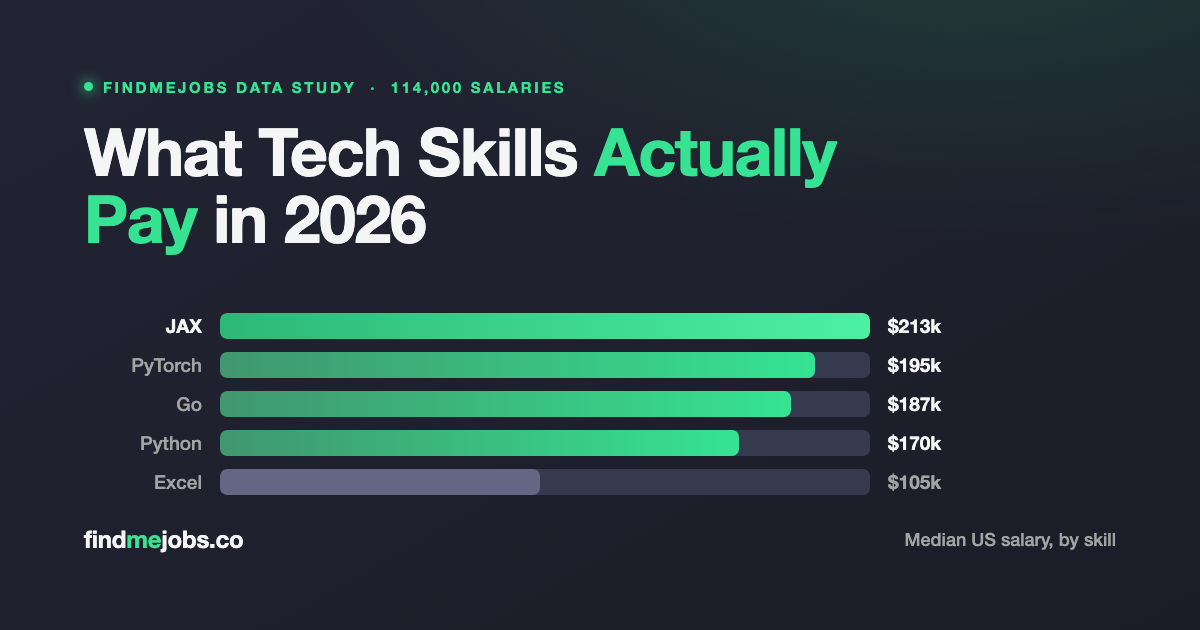
Salary transparency laws have quietly changed the job market: a growing share of US job postings now list a pay range up front. That creates something that barely existed a few years ago — a large, current dataset of what employers are actually willing to pay, straight from the listings themselves.
We analyzed more than 114,000 US job postings that disclosed an annual salary in the FindMeJobs index. Instead of self-reported survey data or a decade of averaged history, this is what companies are offering right now. Here is what every major language, skill, and role actually pays in 2026.
The highest-paying tech skills
The top of the pay scale is not a programming language. It is specialized AI and machine learning skills. Here are the highest-paying skills by median salary (minimum 800 postings each):
The pattern is unmistakable: the skills behind modern AI systems — the deep-learning frameworks (JAX, PyTorch, TensorFlow), the GPU layer (CUDA), and the infrastructure to run models at scale (Flink, distributed systems) — command the highest pay in the market. If you are choosing what to learn next, this is the map.
The lowest-paying tech skills
At the other end, the skills that pay the least are the general-purpose office and business-intelligence tools:
| Skill | Median salary (USD) |
|---|---|
| Excel | ~$105,000 |
| PowerPoint | $105,000 |
| Microsoft Office | $111,000 |
| AutoCAD | $112,500 |
| Power BI | $115,000 |
| Selenium | $117,100 |
| Postman | $117,200 |
The distance is stark. The median JAX role pays roughly twice what the median Excel-centric role pays — a gap of over $100,000. None of these are bad skills to have, but on their own they anchor you to the lower end. Pairing them with a high-value specialization is what moves the number.
Salary by programming language
Narrowing to languages specifically, here is the ranking:
| Language | Median salary (USD) |
|---|---|
| Go | $187,374 |
| Rust | $180,585 |
| TypeScript | $175,000 |
| Python | $170,000 |
| Java | $165,000 |
| JavaScript | $152,150 |
| SQL | $145,500 |
Go and Rust lead the pack — both are systems languages associated with performance-critical infrastructure and well-funded backend teams. TypeScript out-earns plain JavaScript by more than $20,000, a clear signal that type-safe, modern frontend and full-stack work is valued at a premium. SQL alone sits at the bottom, which fits the broader pattern: foundational-but-common skills pay less than scarce, specialized ones.
Software engineer salary, by seniority
"Software engineer salary" hides an enormous range. Here is how it climbs with the ladder:
The jump from senior ($182,940) to staff ($214,500) is over $30,000 — the classic inflection point where compensation growth shifts from "do the work well" to "multiply the work of others." Full-stack roles sit below the general software engineer median, reflecting their breadth-over-depth positioning.
Data scientist salary — and a twist
The median data scientist salary is $155,000, with the surrounding data roles clustered close:
| Role | Median salary (USD) |
|---|---|
| Data Scientist | $155,000 |
| Data Engineer | $151,475 |
| Data Analyst | $92,500 |
The data-analyst-to-data-scientist gap ($92,500 to $155,000) is one of the sharpest title jumps in the dataset. But here is the twist worth internalizing: the AI/ML skills a data scientist lists pay more than the data scientist title itself. Deep learning, PyTorch, and LLM skills all sit above $190,000 — well beyond the $155,000 role median. The takeaway is that at the top of the market, it is the specialized, in-demand skills driving the salary, not the job title on the offer letter.
Do remote jobs pay more?
Counter to the common assumption that remote roles trade pay for flexibility, remote roles in our data pay a modest premium:
| Work type | Median salary (USD) |
|---|---|
| Remote | $162,500 |
| Hybrid | $158,000 |
| On-site | $152,000 |
That is roughly a $10,500 (7%) premium for fully remote roles among US postings that disclosed pay. Remote work concentrates in senior, specialized, engineering-heavy roles — exactly the roles that pay well — which is a large part of why the median lands higher.
What to do with this
The through-line across every table is the same: scarce, specialized, hard-to-hire skills pay a large and consistent premium. If you are deciding what to learn, the AI/ML and distributed-systems stack is where the money is. If you are job hunting now, the roles that use those skills are also the most competitive and the fastest to fill — so being early on the right postings matters as much as the skills themselves. That is what our real-time job alerts are built for: an agent that surfaces matching, well-paid roles within minutes of them going live, so you can apply while the posting is still fresh.
Browse current openings by role or skill to see live salary ranges for your own field.
Methodology
We analyzed more than 114,000 US job postings that disclosed an annual salary (USD) in the FindMeJobs index, covering a rolling window of roughly the last year. Each posting's salary is taken as the midpoint of its stated range, filtered to sane bounds ($20,000 to $1,000,000). Skill- and role-level figures are medians, limited to categories with a sufficient sample (at least 800 postings for skills, and reported sample sizes for roles) for statistical stability. Because only a subset of postings disclose pay — concentrated in salary-transparency states and larger employers — these figures skew toward those segments and are best read as relative comparisons between skills, languages, and roles rather than a universal national average.
Want to catch the high-paying roles in your field before they fill? Start a free FindMeJobs trial — no credit card required — and get matching jobs the moment they post.