You've probably heard the advice before: "Apply as soon as the job goes live." But is there actual research behind it, or is it just another recycled tip from career coaches with nothing concrete to back it up?
The short answer: it's one of the most well-supported, consistently replicated findings in modern recruitment research — and the gap between early applicants and late applicants is far wider than most job seekers realize.
In this guide, we're going to go deep. We'll cover what the data actually says, how recruiting pipelines work behind the scenes, why most job seekers consistently fail to apply early despite knowing they should, and — most importantly — exactly how to build a system that puts you at the front of the line for every single role you care about.
By the end, you'll have a complete playbook you can start using today. Let's get into it.
Here's a scenario that plays out thousands of times every day: A job seeker spends an evening carefully tailoring their resume, writing a thoughtful cover letter, and crafting a personalized application for a role they're genuinely excited about. They hit submit, feeling good about their effort.
They never hear back.
Not because their resume wasn't strong. Not because they weren't qualified. But because when they submitted that application, the recruiter had already scheduled five phone screens from the first wave of candidates who applied 36 hours earlier.
This isn't bad luck. It's a structural feature of how modern recruiting pipelines work — and once you understand it, you'll never approach a job search the same way again.
Let's ground this in data before we go further, because "apply early" is one of those pieces of advice that sounds obvious without people understanding the magnitude of the difference it makes.
24/7 job-alert agent
Stop refreshing job boards
FindMeJobs runs a 24/7 agent that watches for new openings and alerts you on Telegram within minutes of a match going live. Be the first to apply, not the 200th.
Instant Telegram alerts·Free for 7 days. Cancel anytime.
TalentWorks — the most cited data on application timing
The most rigorous study on this topic comes from TalentWorks, which analyzed over 6,000 job applications across 118 industries to identify exactly what drives interview callbacks. Their findings on timing are striking: applicants who apply within the first four days of a posting going live are up to 8x more likely to get an interview than those who apply later. And the decay is fast — every additional day you wait after that reduces your interview chances by approximately 28%.
A separate TalentWorks analysis of 1,610 applications found that applying between 6 AM and 10 AM makes you five times more likely to get an interview than applying after work hours. Combine the early-days advantage with the early-morning window, and TalentWorks calculates this can increase your odds of landing an interview by nearly 40x compared to a late, off-hours submission.
SmartRecruiters — recruiter behavior data at scale
Research from SmartRecruiters, one of the most widely used hiring platforms in the world, shows that Tuesday is the peak day for both job postings and hiring decisions — meaning recruiters are most actively reviewing queues mid-week when their pipelines are being shaped. Their data also shows the US median time-to-hire sits at just 35 days, meaning hiring decisions move faster than most applicants realize. The window between "job posted" and "shortlist formed" is narrow and compresses quickly.
U.S. Bureau of Labor Statistics — the interview-to-offer funnel
The BLS's analysis of job search behavior puts the stakes in sharp relief: applicants who secure at least one interview have approximately a 37% chance of receiving a job offer, while those with no interviews have roughly a 10% chance. The math is unambiguous — getting into the interview stage is the single most important variable in the entire hiring funnel. Timing is the gatekeeper to that stage.
The aggregate picture
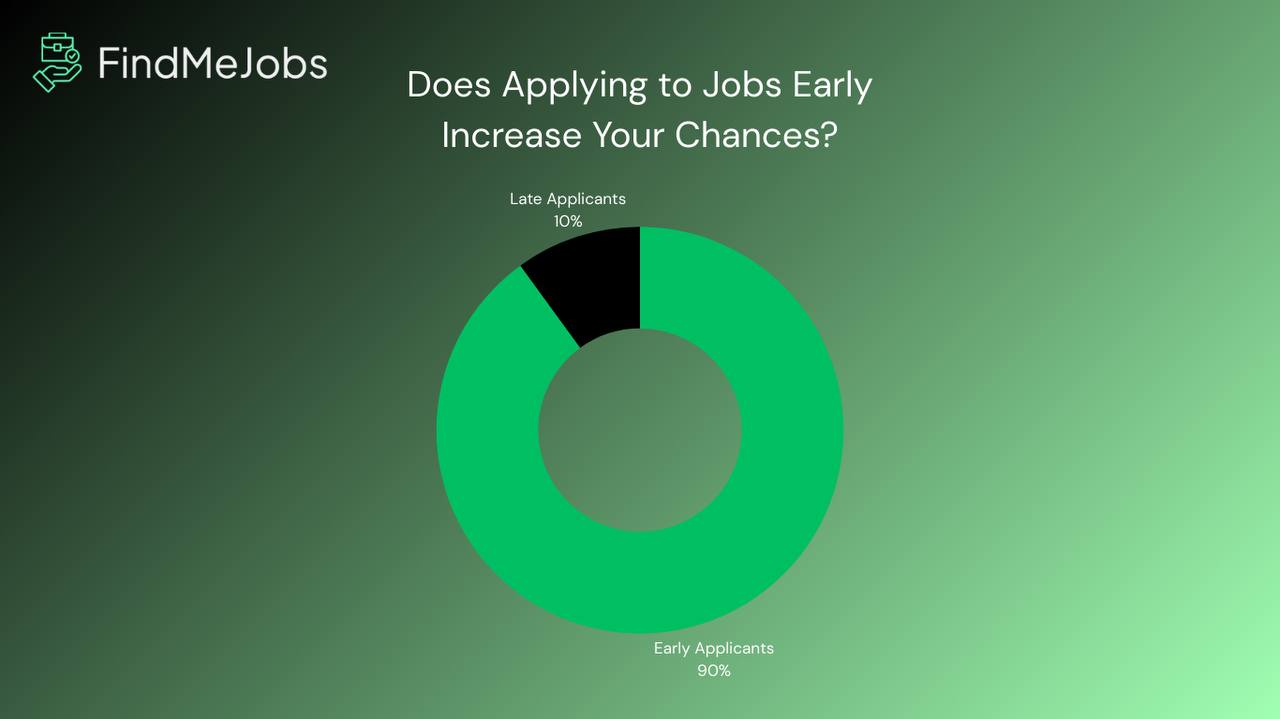
Across these studies and broader ATS platform analytics, a consistent pattern emerges: early applicants capture the overwhelming majority of interview callbacks. A popular remote role at a tech company might attract 500–800 applications in a week. If the shortlist forms within the first 24 to 48 hours — which the data suggests it often does — then the vast majority of that applicant pool never gets a real look, regardless of how qualified they are.
Your qualifications get you the job. But your timing gets you into the room where qualifications are even evaluated.
Understanding why recruiters prioritize early applicants makes the whole dynamic click into place — and it will change how you think about your job search permanently.
Recruiters are not searching for the single best candidate in the world. They're searching for a candidate who is good enough to fill the role well and move the business forward. The moment they find three to five people who clear that bar, their search instinct shifts from "keep looking" to "let's move forward with what we have."
This is why the first wave of applicants exerts so much gravitational pull on the process. If the first 30 applicants include four or five strong fits, the recruiter has everything they need. Every subsequent applicant — even a technically superior one — is now competing for a process that has effectively already started without them.
Most companies use an Applicant Tracking System to manage incoming applications. When a job goes live, the ATS begins logging applicants in order of receipt. Recruiters typically open their ATS dashboard and review the top of the queue — meaning the most recent or earliest applicants, depending on their sorting preference.
In practice, most recruiters sort by "newest first" or "oldest first" and work through the queue linearly until they have enough candidates to move forward. Once they do, they stop. The rest of the queue — potentially hundreds of applicants — often never gets a human review at all.
Most in-house recruiters are managing between 10 and 30 open roles simultaneously. Each posting might generate 100–500 applications. The math is brutal: a recruiter handling 20 roles receiving an average of 200 applications each is theoretically managing 4,000 applications at once.
They simply cannot review every resume thoroughly. Time pressure forces them to make quick decisions based on the candidates they see earliest — which means the window in which careful, thorough review happens is small, and it opens and closes fast.
Here's a detailed look at how application timing maps to interview probability across different types of roles and companies.
Time Since Job Posted
Applicant Queue Position
Recruiter Status
Interview Likelihood
0–60 minutes
Top 1–10 applicants
Inbox just opened
Excellent — you're seen with zero competition
1–6 hours
Top 10–50 applicants
Actively reviewing
Very High — still fresh, shortlist forming
6–24 hours
Top 50–200 applicants
Building shortlist
High — may still make the cut
1–3 days
200–500+ applicants
Shortlist mostly set
Moderate — fighting for remaining spots
3–7 days
500–800+ applicants
In interview phase
Low — screens likely in progress
1–2 weeks
800–1,200+ applicants
Offer stage possible
Very Low — role may be effectively closed
2+ weeks
1,200+ applicants
Closed or on hold
Near zero — resources redirected
These ranges vary by industry, seniority level, and company size — but the directional pattern is universal. The window of opportunity compresses fast, and the longer you wait, the thinner the air gets.
The most common reason people apply late is simple: they find out about jobs late. They're relying on slow, manual discovery methods — checking LinkedIn or Indeed once a day, waiting for weekly job board digests, or scrolling through curated lists that are already hours old by the time they're compiled and sent.
The result is that by the time a job posting hits your awareness, it's already been live for six, twelve, or twenty-four hours. You're not starting from zero — you're already behind.
The fix: Automated, real-time job monitoring. Instead of going to the jobs, the jobs come to you — instantly, the moment they appear. Smart job search agents monitor multiple platforms simultaneously and ping you via Telegram, email, or push notification the moment a matching role goes live. You're not discovering the job at hour 12. You're discovering it at minute 4.
Here's the painful irony many job seekers live with: they know they should apply early, but they also know that generic applications get filtered out. So they feel trapped — apply fast with a weak resume, or take the time to tailor it and lose the first-mover advantage.
This paralysis is real, and it causes a lot of job seekers to do one of two unhelpful things: either send the same generic resume to every posting without thought, or spend two to three hours on each application and inevitably apply late.
Both approaches are losing strategies. But the good news is that the tradeoff is no longer real. AI resume tailoring tools have collapsed the time it takes to customize a resume from hours to seconds. The AI reads the job description, identifies which of your existing experiences align most strongly, flags missing keywords, and suggests specific edits — all before you've even finished reading the posting yourself.
The fix: Use AI tailoring to compress your personalization time to under 60 seconds. Be first and be targeted. These two goals used to be in tension. They no longer are.
Great jobs don't all live in one place. Depending on your industry and target companies, relevant postings might appear on LinkedIn, Indeed, Glassdoor, Greenhouse job boards, Lever-hosted career pages, company websites, Wellfound (AngelList), Dice, Ladders, or dozens of niche vertical boards.
Manually monitoring even a fraction of these sources is a part-time job. Most job seekers end up primarily checking one or two familiar platforms and missing entire categories of relevant opportunities that surface elsewhere first.
The fix: A centralized monitoring tool that aggregates across job boards simultaneously, so you're not creating accounts and saved searches across a dozen different platforms. One set of filters, one alert system, complete coverage.
This is the section where theory becomes practice. Here's a complete, step-by-step system for consistently being among the first applicants for every role you care about. Tools like FindMeJobs are built to handle steps 1 through 4 automatically — but even if you build this system manually, the framework works.
Vague search criteria produce noisy alerts and wasted time. Before you set up any monitoring, get specific about exactly what you're looking for.
Define your target role along these dimensions:
Job titles: List every variation of the title you'd accept. "Software Engineer," "SWE," "Software Developer," "Full Stack Engineer" — these are all different keywords that may or may not appear in any given posting.
Location: Remote only? Specific cities? Willing to relocate? Hybrid?
Salary floor: Only worth your time if compensation meets a minimum threshold.
Seniority level: Mid-level, senior, staff? Many postings don't use standardized language here, so build in synonyms.
Industry or company type: Are you targeting Series B startups? Enterprise companies? Specific verticals like fintech or healthcare?
Required skills: What skills must a role include for it to be relevant? What skills make a posting irrelevant?
The tighter your criteria, the higher the signal-to-noise ratio in your alerts — and the less time you waste evaluating jobs that aren't right for you.
Once you know your target profile, set up automated search agents that watch for it across job boards 24 hours a day, seven days a week. Your goal is to receive an alert within minutes of a matching job posting going live — not within hours.
Look for a monitoring tool that offers:
Multi-platform coverage across all major and niche job boards
Advanced filtering (not just keyword matching — true field-level filters for salary, location, seniority, and skills)
Instant delivery via Telegram or push notification, not just email (email is too slow — you want that ping the moment the job appears)
Alert customization so you can run multiple agents for different role profiles simultaneously
FindMeJobs does all of this out of the box — with real-time LinkedIn job alerts, AI-powered filtering that reads each new posting against your experience range, and monitoring that checks every ten minutes. This step alone will dramatically change your position in every applicant queue, because you'll be responding to postings in their first minutes rather than hours or days later.
The worst time to think about your resume is when a job alert just landed and you're trying to apply in the next five minutes. Your base resume should be thorough, polished, and completely ready before you start monitoring.
Your master resume should include:
A strong professional summary that captures your overall value proposition
Every role you've held with full bullet points covering responsibilities, achievements, and metrics
A comprehensive skills section covering all technical, domain, and soft skills
Education, certifications, and relevant projects
This master resume is not meant to be sent anywhere — it's your source document. Think of it as your complete inventory of professional assets, from which you select and arrange the most relevant items for each specific role.
Having this ready means that when it's time to tailor for a specific posting, you're doing curation and editing — not writing from scratch.
Follow-up date (typically 5–7 business days after applying)
Current status
Following up after applying is an underused lever. A brief, professional note to the recruiter on LinkedIn or via email — mentioning your excitement about the role and checking on timeline — can refresh your visibility in their queue and signal genuine interest. Not every recruiter responds positively to follow-up, but many do, and the upside is worth the small effort.
Since tailoring speed is so critical to this system, it's worth going deeper on what effective, fast tailoring actually looks like. (We also wrote a full guide on why most resumes don't get responses — including the six most common mistakes and how to fix each one.) The goal is not to rewrite your entire resume — that's too slow and too risky. The goal is to make targeted, high-leverage edits that signal alignment with the specific role.
Your professional summary. This is the highest-visibility section and the easiest to customize. Pull two or three phrases from the job description and mirror them in your summary. If the job says "cross-functional collaboration" and you've done that, say so explicitly — use that phrase.
Your top bullet points. Reorder your bullets within each role to put your most relevant accomplishments first. If the job emphasizes performance optimization and you have a bullet about improving page load speeds by 40%, that should be bullet one — not buried at the bottom.
Keywords in your skills section. ATS systems scan for keywords. If the job lists specific tools, languages, or frameworks that you have experience with but haven't explicitly named in your resume, add them. Matching the language of the job description to your skills section directly improves your ATS pass-through rate.
Role titles when applicable. If your previous job title was "Software Development Engineer" but the target role uses "Software Engineer," it may be worth adjusting your listed title to match common conventions — assuming the change is honest and your actual role was equivalent.
Your core facts and accomplishments. Never exaggerate metrics, fabricate results, or claim skills you don't have. Beyond being dishonest, it backfires spectacularly in interviews when you can't speak credibly to something on your resume.
Your entire resume structure. A complete rewrite for every application is too slow and risks losing what already works. Treat your resume like a template with variable components — change the dynamic parts, leave the foundation alone.
Formatting that's already working. If you have an ATS-friendly format, don't redesign it for every application. Your layout should be a permanent fixture that you never touch — only content changes.
The urgency of applying early varies by industry, role type, and company size. Here's a practical guide to calibrate your response time based on what you're targeting.
Industry / Role Type
Avg. Applications in 24 Hours
Recommended Response Time
Software Engineering (Remote, Big Tech)
300–800+
Within 1–2 hours
Product Management (Tech)
200–500
Within 2–4 hours
Marketing / Growth (Consumer Brand)
150–400
Within 2–6 hours
Data Science / ML
200–600
Within 1–3 hours
Finance / Investment Banking
100–300
Within 4–8 hours
Sales (SaaS, B2B)
100–250
Within 6–12 hours
Healthcare Administration
50–150
Within 12–24 hours
Senior Leadership (Director+)
30–100
Within 24 hours
Niche Technical Roles (Rare Skills)
10–50
Within 24–48 hours
Executive / C-Suite
10–30
Within 48–72 hours
Notice that the most commonly targeted roles — software engineering, product management, marketing — also have the smallest effective windows. These are precisely the categories where first-applicant positioning matters most and where the competition moves fastest.
One of the underappreciated aspects of this strategy is how it compounds over time.
When you apply late, you're not just losing one opportunity — you're operating at a consistent structural disadvantage across your entire job search. Every application starts behind. Every role has a smaller window than it appears. Your hit rate stays low no matter how good your resume is, because timing is working against you at every step.
When you apply consistently early, the dynamic inverts. Your application hit rate goes up. More interviews mean more practice, better negotiation leverage, and faster progression to offers. A job search that might have taken four months of frustrating silence can compress to six to eight weeks of real momentum — with multiple offers, not just one.
This isn't a marginal improvement. It's a structural shift in how your job search performs. The candidates who get three competing offers in a short window aren't necessarily dramatically more qualified than those who job search for a year with nothing to show for it. Often, they've just mastered timing.
Does applying early matter if the job has been posted for a while?
If a job has been posted for more than a week and is still visible, there are a few possible explanations: the company is having trouble filling it, they've broadened their search, or the posting is still live but the process is already advanced. In any of these cases, applying still makes sense — but managing your expectations is important. If the role is more than two weeks old, try to find a direct contact to reach out to alongside your application, which can give you a visibility boost that pure queue timing can no longer provide.
Does the quality of the application matter more than timing?
Both matter enormously — which is why the winning strategy is to be both fast and targeted. A weak, generic application sent in the first hour will still get filtered out. A brilliant, perfectly tailored application sent four days later may never get read. The combination of excellent quality delivered at high speed is what consistently produces interview rates above the industry average.
What's the best time of day to apply to jobs?
Recruiters tend to review applications first thing in the morning, typically between 8 and 10 AM in their local time zone. If you apply the evening before or early morning, you have a strong chance of appearing near the top of their review queue when they open it. Applying at 11 PM or on weekends isn't ideal, but being early in the queue matters more than the specific hour — so don't delay a strong application just because it's not peak hours.
Should I apply through LinkedIn Easy Apply or directly on the company website?
Both have tradeoffs. LinkedIn Easy Apply is faster and has a lower friction barrier — but some companies receive so many Easy Apply submissions that recruiters deprioritize them in favor of direct ATS applicants who they perceive as more motivated. When you have the option, applying directly through the company's ATS (Greenhouse, Lever, Workday, etc.) often signals stronger intent. That said, speed is paramount — if Easy Apply means you apply 30 minutes faster than going through the ATS, it may be worth it for time-sensitive roles.
Is it worth following up after applying?
Yes, in most cases. A brief, professionally worded message to the recruiter or hiring manager — sent 5 to 7 business days after applying — can refresh your visibility and demonstrate genuine interest. Keep it short: mention the role you applied for, one sentence about why you're excited about it, and a low-pressure ask about timeline. Don't follow up more than once unless they engage with you.
How many jobs should I apply to per week using this strategy?
Quality over quantity still applies — but "quality" now includes timing as a core variable. With a real-time monitoring and fast tailoring system, targeting 10 to 20 highly relevant roles per week is realistic and sustainable. This is far better than spraying 100 applications with a generic resume, or sending 5 beautifully crafted applications that all land after the shortlist is made.
What is the 80% rule in hiring?
The 80% rule refers to the idea that if you meet roughly 80% of a job posting's listed requirements, you should apply. Most job descriptions describe an ideal candidate, not the minimum bar — and recruiters know this. Waiting until you're a 100% match before applying means you're likely over-qualifying yourself out of roles you'd get, and — critically — you're losing time. Combined with the early applicant advantage, the 80% rule becomes even more powerful: apply fast when you're a strong-enough fit, rather than waiting to find a "perfect" match that may not exist.
Does it matter if I apply on a weekend or late at night?
Applying during off-hours is better than not applying at all. However, data from TalentWorks suggests that applications submitted between 6 AM and 10 AM on weekdays see higher callback rates — likely because they land at the top of the recruiter's queue when they start their day. If a role is freshly posted on a Friday evening, apply immediately rather than waiting until Monday morning. Being early in the queue consistently outweighs time-of-day optimization.
The early applicant advantage is one of the most concrete, data-backed insights in all of job searching — and it's one that most people systematically ignore because they don't have the infrastructure to act on it.
The research is clear: apply in the first 24 hours and you're competing in a different game than applicants who show up later. Apply in the first hour with a tailored resume, and you're in the best possible position a job seeker can occupy — seen early, looking relevant, with an empty inbox ahead of you.
The job search system that gets you there isn't complicated. It's monitoring + speed + smart tailoring, working together. Set it up once, and it fundamentally changes the math on every application you send from that point forward.
Stop chasing postings that are already cold. Start getting to them before anyone else does.
FindMeJobs monitors top job boards 24/7 and sends you instant alerts the moment a matching role appears. Then our AI tailors your resume in under 30 seconds — so you can be first in line with a targeted application every single time. Start your 7-day free trial today. No credit card required.
Apr 2, 2026|14 min read|FindMeJobs Team
How to Evaluate a Job Offer: A 5-Point Scorecard (2026)
Offer acceptance rates hit 51% in Q2 2025. Use this 5-dimension scorecard to evaluate any job offer on compensation, role quality, growth, culture, and risk.