Most interview advice focuses on answering questions well. Almost none of it focuses on asking them — which is a significant gap, because the questions you ask at the end of an interview are evaluated by the interviewer just as carefully as the answers you gave throughout it.
According to CareerBuilder's survey of hiring managers, not asking questions is one of the three most common interview mistakes candidates make — flagged by 38% of interviewers as a reason to discount a candidate. Think about what that means: more than one in three interviewers are actively noting when a candidate doesn't ask anything, and treating it as negative signal.
The reason is straightforward. An interviewer who asks you questions for 40 minutes is gathering data about your skills, your experience, your communication style, and your judgment. When they ask "do you have any questions for me?" — they are still gathering data. The questions you ask reveal whether you've done genuine research, whether you think strategically, whether you care about the role beyond the salary, and whether you're the kind of person who brings intellectual curiosity to their work.
Saying "no, I think you've covered everything" is not modest. It's a missed opportunity to demonstrate every one of those qualities in a single exchange that takes less than five minutes.
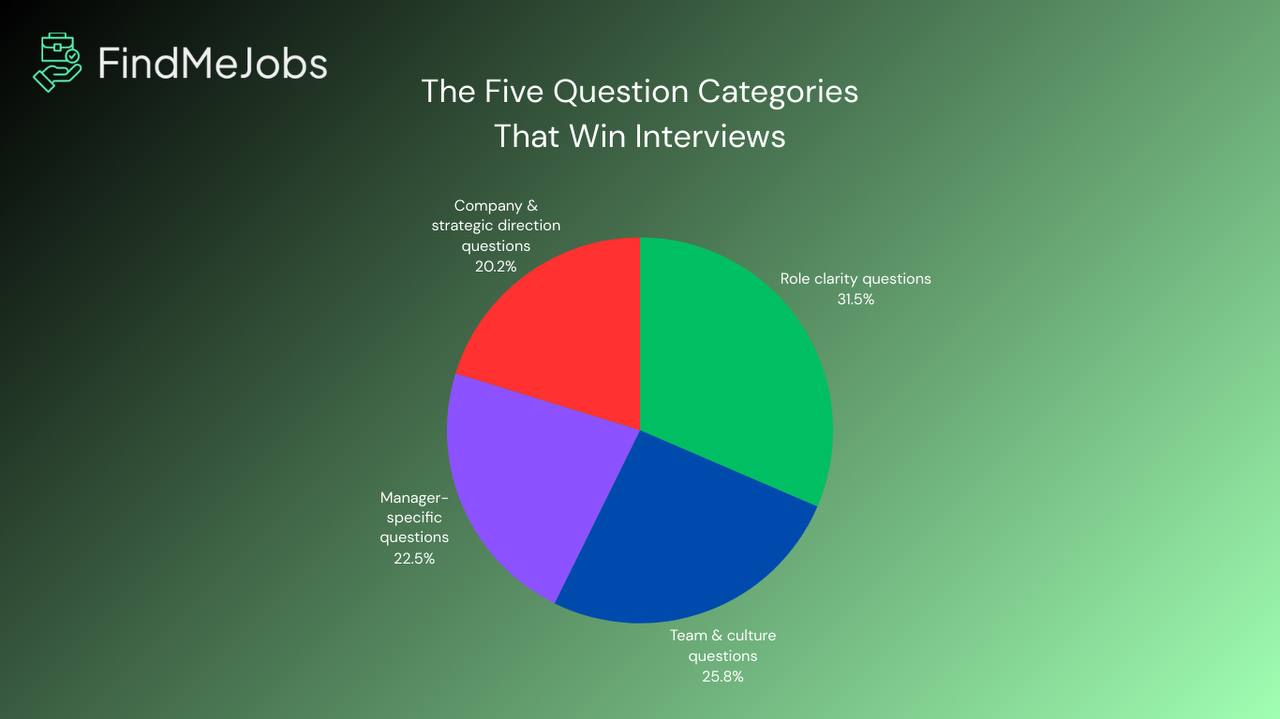
This guide explains what your questions actually signal, the five categories that produce the strongest impressions, 30 specific questions you can use, and the questions that reliably backfire — with the data behind all of it.
What Your Questions Signal to the Interviewer
Before the specific questions, the psychology — because understanding what the interviewer is actually evaluating changes how you choose and frame what you ask.
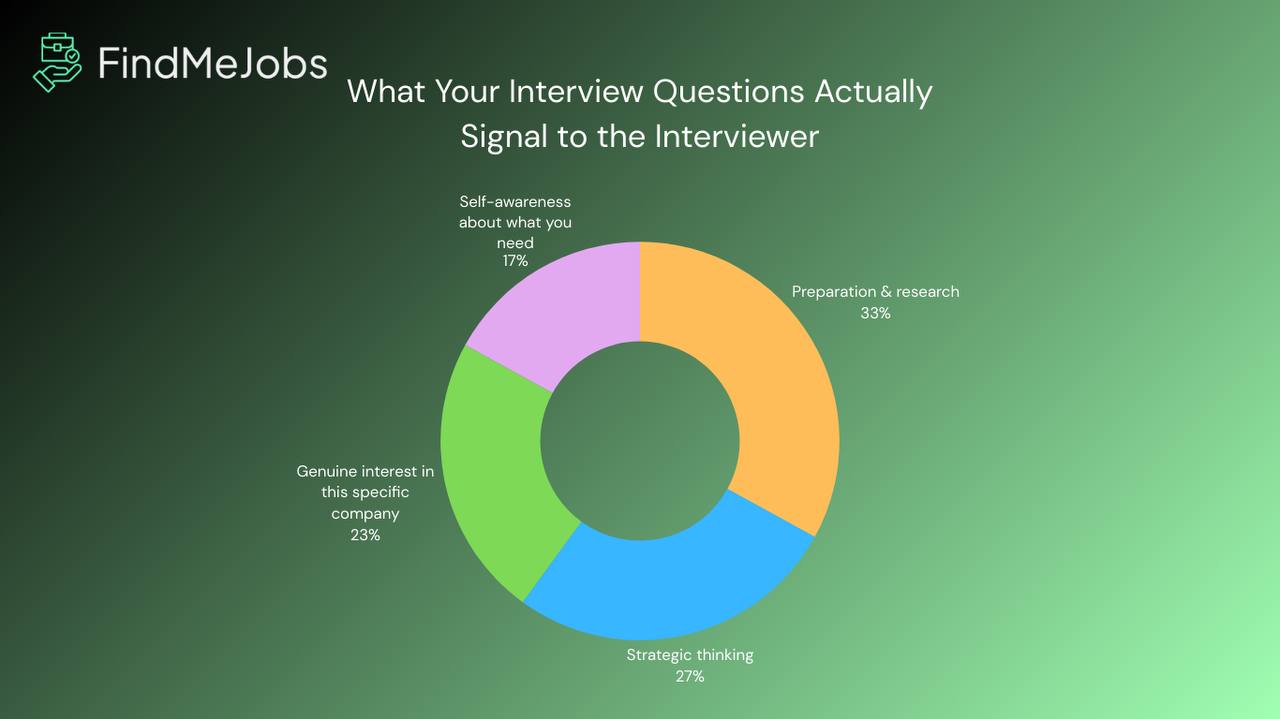
When a hiring manager hears your questions, they're running four assessments simultaneously:
Preparation and research. Did you do your homework before walking in? A question that could be answered by reading the company's About page signals minimal preparation. A question that references a specific product launch, a recent earnings report, or a detail from the hiring manager's own LinkedIn signals that you took the role seriously enough to invest time before the conversation.
Strategic thinking. Do you understand how this role fits into the larger picture? Questions about team structure, success metrics, and business priorities reveal whether you're thinking about how to be effective in the role — not just whether you'll enjoy it.
Genuine interest in this specific company. The interviewer has heard dozens of candidates express enthusiasm for the role. Questions that could apply to any company at any stage ("what does growth look like here?") are less convincing than questions that are specific to this company's situation, challenges, or moment. Specificity is evidence of genuine interest in a way that general enthusiasm is not.
Self-awareness about what you need to succeed. Questions about management style, team dynamics, and how success is measured reveal that you're evaluating the role thoughtfully — not just trying to get any offer. Interviewers generally prefer hiring candidates who are selective, because selective candidates who accept offers are more likely to stay.
The questions that score highest across all four assessments are specific, forward-looking, and show evidence of preparation. The ones that score lowest are generic, backward-looking, or focused entirely on what the company can do for you before you've demonstrated what you can do for them.
The Five Categories of Questions That Work
Category 1: Role Clarity Questions
These questions show that you're already thinking about how to be effective in the position — not just whether you want it. They signal ambition without arrogance, and they give you genuinely useful information for deciding whether to accept an offer.
"What does success look like in this role at 30, 60, and 90 days?" This is one of the most consistently well-received questions in any interview. It demonstrates that you're already thinking about your first quarter and that you understand performance is measured, not assumed. It also gives you a concrete picture of what you're actually signing up for — many candidates accept roles with vague expectations and discover the gap after they start.
"What are the two or three most important things you'd want someone in this role to accomplish in the first six months?" A variation on the above, but more conversational. It invites the interviewer to share what's actually on their mind rather than what's in the job description — which are often very different things.
"What are the biggest challenges the person in this role will face in the first year?" One of the most strategically valuable questions you can ask. It reveals what the hiring manager is actually worried about, which tells you whether you have the specific capabilities to address those concerns — and gives you an opportunity to speak to them directly if you haven't already.
"How has this role evolved since it was created, or how do you expect it to evolve?" For roles that have existed before, this tells you whether the scope is expanding or contracting. For newly created roles, it tells you how much definition exists and how much you'd be expected to create. Both are critical pieces of information.
Category 2: Team and Culture Questions
These questions reveal whether the environment is one where you'll actually thrive — and they signal that you understand culture matters to performance, not just enjoyment.
"How would you describe the team's working style?" Open-ended enough to invite a genuine answer, specific enough to be meaningful. The answer tells you whether the team is collaborative or independent, fast-paced or deliberate, process-heavy or entrepreneurial.
"What does communication typically look like between this role and the rest of the team?" Particularly valuable for any role involving cross-functional work, remote components, or multiple stakeholders. The answer reveals whether communication is structured or ad hoc, synchronous or async — which matters significantly for how you'd actually experience the job.
"What do you think makes someone truly successful in this team's environment, beyond the technical requirements of the role?" This question asks the interviewer to articulate what's implicitly valued — which is often different from what's explicitly stated in a job description. The honest answer usually reveals the cultural values that determine who thrives and who doesn't.
"How does the team typically handle disagreement or conflicting priorities?" A slightly bolder question that signals psychological maturity. It acknowledges that conflict is a normal part of any team and that you're not afraid to ask about it directly. The answer is highly revealing — both for what it tells you about the team and for how the interviewer responds to a direct question.
Category 3: Manager-Specific Questions
When you're speaking with the person who would be your direct manager — as opposed to HR or a recruiter — these questions are among the highest-value you can ask. They demonstrate that you take the reporting relationship seriously, and they give you critical information for evaluating whether this is someone you'd actually want to work for.
"How would you describe your management style?" A classic for good reason. The answer reveals both the manager's self-awareness and their actual approach. Watch for specificity — "I'm very hands-off" is less informative than "I try to check in weekly, give clear context on priorities, and then get out of the way."
"How do you typically give feedback, and how often?" This question tells you whether you'll know how you're doing in the role before your annual review, or whether you'll be flying blind. It also signals that you're someone who actively seeks feedback — which most managers respond to positively.
"What's something you've learned or changed about how you manage people?" This is a more personal question that works particularly well once some rapport has been established. It invites reflection and humility, and the answer reveals a great deal about the manager's growth mindset and self-awareness. A manager who can answer this thoughtfully is almost always a better manager than one who can't.
"What do the most successful people on your team have in common that isn't obvious from their job descriptions?" One of the most insightful questions in this entire guide. It asks the manager to articulate what they actually value, which is often different from what they say they value. The answer tells you whether you'd fit.
Category 4: Company and Strategic Direction Questions
These questions signal that you're thinking about the organisation at a level above the role itself — and that you're interested in whether the company is heading somewhere you want to go.
"What are the biggest strategic priorities for the company over the next 12 to 18 months?" Shows that you think about your work in a broader context. Also useful for evaluating whether the company's direction is one you're genuinely excited about.
"How does this role contribute to those priorities?" A natural follow-up to the above. It demonstrates that you connect role-level work to company-level outcomes — a quality that hiring managers and senior leaders specifically look for when evaluating candidates for positions with any strategic component.
"What does the competitive landscape look like right now, and how is the company positioned?" A stronger question, appropriate when interviewing with a hiring manager or senior leader rather than HR. It signals commercial awareness and an interest in understanding the business, not just the job.
"I noticed [specific recent company news, product launch, or development]. How is that affecting the team or the priorities of this role?" The highest-signal question in this category — but only if the "specific recent thing" is genuinely specific and demonstrates real research. A question referencing something vague ("I saw the company has been growing") is worse than no question. A question referencing the company's Q3 product announcement or a recent leadership hire shows that you've paid attention in a way that almost no other candidates have.
Category 5: Next Steps and Process Questions
These questions are practical rather than evaluative — but they're important for managing your own expectations and for demonstrating professional confidence by being direct about what happens next.
"What are the next steps in the process from here, and what's the timeline you're working toward?" The single most useful practical question you can ask. It gives you information to manage your follow-up correctly and signals that your time matters to you — which is a professional quality, not a presumptuous one.
"Is there anything from our conversation today that you'd want me to clarify or address before we wrap up?" A remarkably effective closing question. It gives the interviewer permission to surface any hesitation they have about your candidacy — which, if addressed well, can turn a soft "maybe" into a "yes" before you leave the room. Most candidates never ask this, which means most candidates leave without addressing the doubt that cost them the offer.
"What's the main quality you're looking for in the person who gets this role?" Strategically valuable because it tells you exactly what to reinforce in your thank-you email. Whatever the interviewer says in answer to this question is what you should directly address — with a specific example or framing — when you follow up within 24 hours.
How Many Questions to Ask
The research-consistent answer: prepare eight to ten questions, plan to ask four to six, and let the conversation determine which ones are still relevant by the time you reach the end.
Some of your prepared questions will be answered naturally during the interview. That's fine — you should acknowledge it ("you actually addressed this earlier, but I'd love to hear more about...") rather than skipping it entirely if it's genuinely important to you. The acknowledgment itself signals that you were listening throughout the conversation, not just waiting to recite your prepared list.
Never ask fewer than three questions when invited to. One or two questions reads as minimal preparation or low interest. Three to five reads as engaged, specific, and appropriately concise. More than six risks the conversation running long or the interviewer feeling interrogated rather than engaged.
For panel interviews, direct different questions to different panel members — based on their role and what they'd be best positioned to answer. Directing a question about day-to-day management style to a technical lead rather than to the person who'd be your actual manager is a misstep that reveals you haven't thought about who you're talking to.
What Never to Ask
These questions reliably produce negative impressions — either because they signal the wrong priorities, reveal poor research, or create awkwardness that's difficult to recover from.
"What does your company do?" This is the interview equivalent of forgetting someone's name immediately after being introduced. If you don't know what the company does before the interview, you weren't prepared — and no answer to this question helps you recover from that signal.
"What are the hours / how much vacation do I get / when do I need to be in the office?" These questions are not inappropriate information to want — but asking them before you have an offer frames you as someone whose primary concern is minimising your obligations rather than maximising your contribution. Save all compensation and benefits questions for after an offer is on the table, when you're in a negotiating position rather than an audition one.
"How quickly could I get promoted?" Signals ambition in the wrong direction — it suggests you're already thinking about leaving the role you haven't yet started. Better to ask about growth and development in terms of skills and scope rather than title and seniority.
"Did I get the job?" Putting the interviewer on the spot in this way creates discomfort rather than confidence. If you want to signal strong interest in the role, the closing question "Is there anything from today you'd want me to clarify?" does so far more effectively — and it invites a genuine response rather than an awkward deflection.
Questions about information available on the company's website. If the company's values, headcount, founding year, or product suite are on their homepage, asking about them in an interview signals that you didn't spend 20 minutes doing the research anyone serious about the role would do. Every question you ask should demonstrate preparation, not reveal its absence.
The Thank-You Email Connection
The questions you ask in the interview are directly connected to the follow-up you send afterward — and TopResume's research found that 68% of hiring managers say receiving a thank-you email influences their hiring decision, with nearly 20% admitting they've dropped a candidate specifically for not sending one.
The link between questions and follow-up is this: whatever the interviewer tells you in answer to your closing question — "what's the main quality you're looking for in the person who gets this role?" — becomes the anchor for your thank-you email. You reference it specifically, address it directly with a relevant example or framing, and close with your genuine interest in the position.
This is the sequence:
- Ask the closing question
- Listen carefully and note the answer
- Within 24 hours, send a thank-you that directly addresses what they said
Almost no candidates do this. The combination of a strong closing question and a targeted follow-up within 24 hours is one of the highest-ROI sequences in the entire interview process — and it's available to every candidate in every interview.
The Company Research Question
One statistic from the data sits above all the others in practical importance: 47% of candidates fail job interviews due to insufficient knowledge about the company they're interviewing with.
That number — nearly half of all interview failures attributable to a single, entirely preventable cause — reflects a specific pattern. Candidates prepare their answers. They practise "tell me about yourself" and "what's your greatest weakness." They think about their portfolio. And then they walk into an interview and, when asked "what do you know about us?" or "why do you want to work here specifically?", give a generic answer that could apply to any company in the sector.
The questions you ask are the most visible proof that you didn't make this mistake. A question that references a specific detail about the company — its recent expansion, a product feature you've actually used, a challenge the industry is facing that this company is positioned to address — does more to demonstrate company knowledge than any answer to a direct question about it. It shows rather than tells.
Before every interview, identify one specific, recent, interesting thing about the company that connects to your reason for wanting the role. Build a question around it. That question will do more for your candidacy than any of the general preparation most candidates spend their time on.
Frequently Asked Questions
How many questions should I ask at the end of a job interview?
Between three and five is the optimal range for most interviews. Fewer than three reads as low preparation or low interest. More than six risks the conversation running over time or the interviewer feeling interrogated. Prepare eight to ten questions in advance — some will be answered during the interview, leaving you with the right number to ask at the end.
What is the best question to ask at the end of an interview?
"Is there anything from our conversation today that you'd want me to clarify or address before we wrap up?" consistently produces the highest strategic value. It gives the interviewer permission to surface any hesitation about your candidacy — and it gives you one last opportunity to address it directly. Almost no other candidates ask this question, which means most leave without resolving the doubt that cost them the offer.
Should I ask questions in a first-round phone screen?
Yes — but calibrate the depth. A phone screen with an HR recruiter calls for different questions than a final-round panel interview with the executive team. In a phone screen, appropriate questions include: what does the interview process look like from here, what are the key things you're evaluating in this stage, and what does success look like in this role in the first 90 days. Avoid deep strategic or cultural questions in a phone screen — save those for the in-person rounds where the conversation has more depth.
What if the interviewer has already answered all my questions?
Acknowledge it specifically: "You actually covered a lot of what I had in mind — particularly what you said about [specific thing]. The one thing I'm still curious about is..." This response is better than asking a question for the sake of it, and the acknowledgment signals that you were genuinely listening throughout the interview, not just waiting for your turn to speak.
Is it okay to bring a list of questions to the interview?
Yes — and it's generally seen as a sign of preparation rather than reliance on notes. A clean, organised list of questions signals that you took the interview seriously enough to prepare thoughtfully. Don't read directly from the list without making eye contact, and don't mechanically work through it top-to-bottom. Use it as a reference while keeping the conversation natural.
When is the right time to ask about salary?
Not in a first interview, and not in response to the invitation to ask questions — unless the interviewer raises compensation themselves or explicitly invites the conversation. The appropriate moment is after an offer is on the table, when you have real negotiating leverage. Raising it earlier frames you as someone whose primary interest is the package rather than the role, and it puts the interviewer in an uncomfortable position before a decision has been made.
What if I'm interviewing with multiple people on the same day?
Prepare a varied set of questions and direct different ones to different interviewers based on their role. Ask the hiring manager about team dynamics and success metrics. Ask a potential peer about what they find most interesting or challenging about their work. Ask a senior leader about strategic direction. Asking everyone the same questions in a panel format suggests you haven't thought about who you're talking to — and that observation applies to how you'd work with the team as much as to the interview itself.
Does asking good questions actually change hiring decisions?
Yes — both the data and the logic support it. The CareerBuilder data shows 38% of interviewers specifically flag not asking questions as a negative. The inverse is also true: a well-researched, specific question that demonstrates genuine interest and strategic thinking can shift a borderline decision. Interviewers are human; they respond to being asked good questions by someone who is clearly paying attention. The five minutes of questions at the end of an interview are disproportionately influential relative to their length — and they're almost entirely within your control.
The Bottom Line
The invitation to ask questions is not a formality. It is the final evaluated section of every interview — and for a meaningful percentage of candidates, it's where the decision tips one way or the other.
The candidates who use it well don't do so by memorising a list of "impressive" questions. They do so by taking the role and the company seriously enough to prepare specific, genuine questions that reveal their thinking — and by listening carefully enough throughout the interview to adapt those questions to the conversation that actually happened.
Prepare more questions than you'll use. Make at least one of them specific to something you researched about this company before you walked in the door. Close with the question that gives you one last chance to address any doubt. Follow up within 24 hours with a thank-you that references what the interviewer told you.
That sequence — applied consistently across every interview — is one of the highest-leverage things any candidate can do. And it costs nothing except the preparation most candidates skip.
You may also find useful:
- How to Explain Your Employment Gap in an Interview
- Why You're Not Hearing Back from Job Applications
- How Many Jobs Should You Apply to Per Week?
Getting to the interview is the hardest part. Only 2% of applicants make it to an interview for the roles they apply to — which means the window opens rarely and closes fast. findmejobs.co monitors job boards 24/7 so you're always in the first-applicant window, before the shortlist forms. Start your 7-day free trial — no credit card required.