Smart search is context-aware retrieval that combines traditional indexing, Boolean logic, and AI-driven ranking. In job discovery, it can interpret “senior backend engineer, Go or Rust, remote, not staff,” filter the available roles, and rank the most relevant fresh postings instead of returning every page containing those words.
At 9 a.m., Maya opens three job boards and searches for “data analyst.” The first results include old listings, junior roles, and jobs in locations she can't work from. A relevant posting went live at 8:47, but it sits below loosely related results. By the time she finds it, other candidates have already applied.
That situation captures the practical reason people ask what is smart search. The difference isn't whether a search box uses AI. The question is whether the system can understand what the user means, enforce hard requirements, compare related language, and surface useful results while they're still actionable.
Traditional search starts with literal terms. It looks through an index for documents containing words such as “data,” “analyst,” or “SQL,” then applies scoring rules based largely on where and how often those terms appear. That approach is still valuable, especially when the user knows the exact identifier, title, or phrase they want.
Smart search adds context. It interprets “data analyst” alongside signals such as seniority, location, work arrangement, skills, posting date, and the likely purpose of the query. In a job system, “find me a senior remote analytics role using SQL and Tableau” isn't treated as one long string. The system separates the request into concepts, constraints, and preferences.
A useful working definition is:
Smart search is a retrieval pipeline that understands intent and context, combines literal matching with structured filters, and uses learned ranking to order the results.
The underlying system usually includes three layers:
Only after that foundation is clear do the technical labels become useful. Lexical search focuses on matching words and tokens. Semantic search compares meaning, so “business intelligence specialist” may connect with a query for “BI analyst.” Hybrid search combines both approaches instead of forcing the system to choose one.
For Maya, a smart result isn't merely a posting that contains “data analyst.” It might be a recently published senior analytics role whose description says “business intelligence,” lists SQL and Tableau, supports her location, and matches her preferred work arrangement. The system can still require exact conditions while using semantic understanding to catch varied wording.
The key takeaway is simple: smart search is a pipeline, not a feature. Each stage contributes something different, and a failure in one stage can make the final results feel unintelligent.
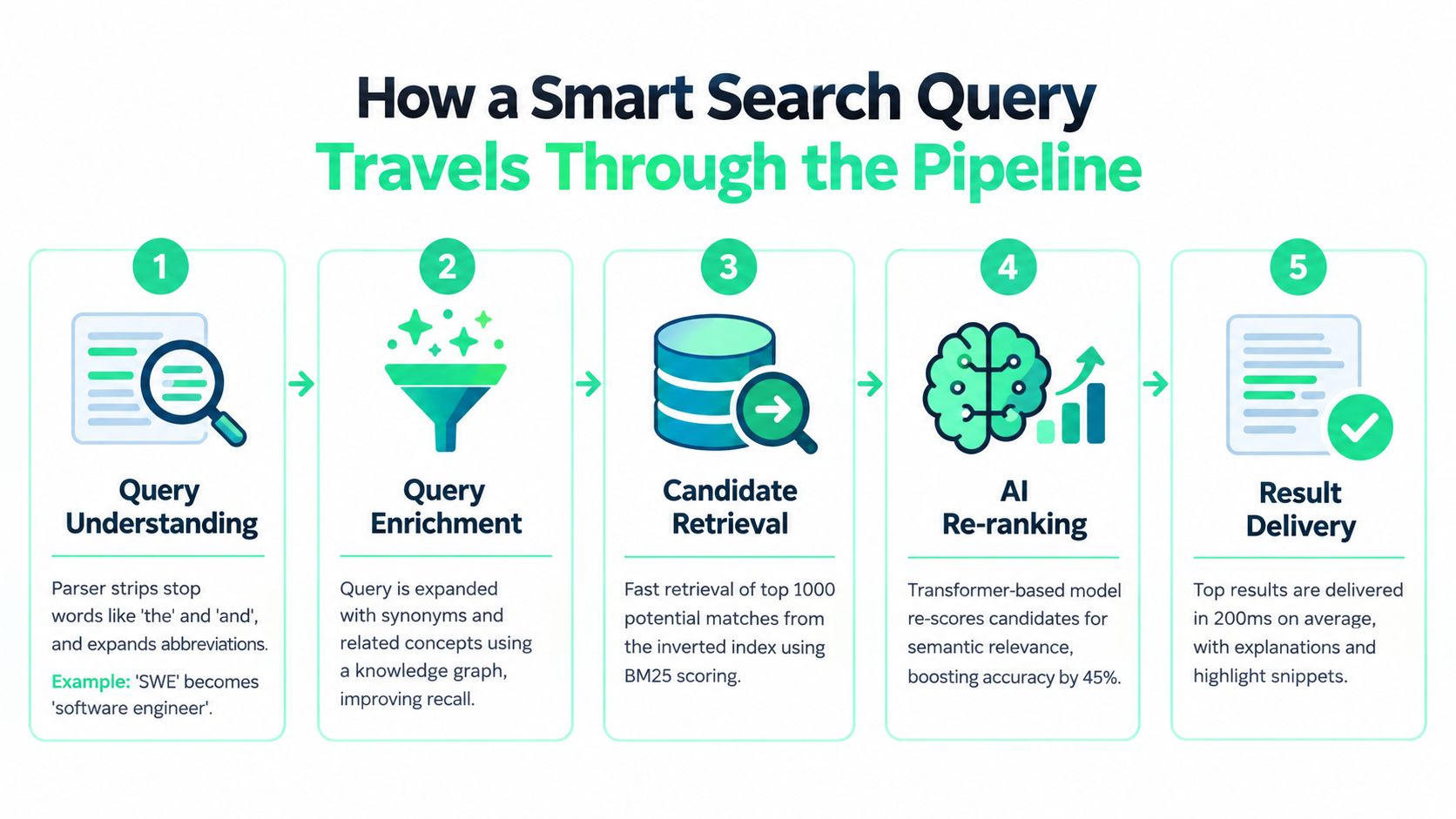
A production search request usually travels through several stages. The system doesn't send the entire index to an AI model for every query. It narrows the field quickly, combines retrieval methods, then spends more computation on the most promising candidates.
The parser first cleans and interprets the request. It may remove low-value stop words, recognize an abbreviation such as “SWE,” and expand it to “software engineer.” It also detects whether the user wants a known page, an explanation, or an action-oriented result such as a job listing.
This stage can identify entities and constraints. “Senior platform engineer in Toronto, remote, Go” contains a role, level, location, work arrangement, and skill. A good parser preserves those distinctions instead of flattening them into an undifferentiated bag of words.
The system then retrieves a broad candidate set. A lexical retriever searches the inverted index, often using a relevance function such as BM25. A semantic retriever performs approximate nearest-neighbor search over embedding vectors, adding postings that express the same idea with different language.
Candidate generation optimizes recall. It should avoid missing a potentially relevant job, even if some returned postings are weak matches.
The lexical and semantic lists are merged through reciprocal-rank merging, weighted scoring, or a learned combiner. A learning-to-rank model then examines the strongest candidates in more detail and reorders them using query context, job fields, interaction signals, and relevance features.
For time-sensitive content, freshness can influence the final order. Google Cloud's job-search best-practices guidance describes ranking controls such as rankingExpression and importanceLevel, and notes that broadening and keyword-match settings affect both the number and relevance of returned jobs.
Each stage leaves a diagnostic trail:
A 2026 job-matching study reported an MRR of 0.76, meaning the first relevant result generally appeared within the top two positions, as reported in the job-search market and citation analysis. For job seekers, that ranking quality matters because the first useful result is the one most likely to receive attention immediately.
AI ranking doesn't replace explicit rules. It operates inside boundaries defined by the query and the system's filter model.
Consider this job-search request:
"senior backend engineer" AND (Go OR Rust) AND NOT "staff"
The parser can convert it into a filter tree. The title or normalized role field must match the senior backend engineer phrase, the skills field must contain Go or Rust, and postings labeled staff are excluded. Semantic ranking can then compare the remaining jobs by meaning and overall fit.
This distinction matters. Boolean logic defines the candidate pool. Semantic retrieval and AI ranking decide which candidates deserve attention within that pool. A model shouldn't rescue a posting that violates a hard requirement such as work authorization or location.
Structured filters usually act as hard constraints before expensive ranking begins. A job board can filter by posting date, remote flag, salary range, employment type, clearance status, or location. The system may still rank the survivors semantically, but it doesn't need to ask the model to reason about every document in the index.
| Operator | Syntax Example | What It Does | Typical Use in Job Search |
|---|---|---|---|
| AND | Python AND Django | Requires both concepts | Roles needing a language and framework |
| OR | Go OR Rust | Accepts either concept | Related or alternative skills |
| NOT | NOT staff | Excludes a term or concept | Avoiding unwanted levels or domains |
| Exact phrase | "senior backend engineer" | Keeps words together as a phrase | Matching a precise title |
| Grouping | (Go OR Rust) AND Kubernetes | Controls evaluation order | Combining alternatives with a required skill |
| Proximity | Python NEAR/5 Django | Finds terms within a defined span | Skills mentioned together in a description |
If you want the operator-by-operator version with copy-ready strings, our guide to boolean job search covers the syntax across LinkedIn, Google, and the major boards.
A structured interface might represent the same request as separate controls: title contains “backend engineer,” level equals senior, skills include Go or Rust, and level does not equal staff. That representation is often safer than asking users to write raw syntax, because the interface can validate fields and prevent ambiguous interpretation.
Practical rule: Put hard requirements in filters, not in vague natural-language instructions to the ranking model.
When results feel wrong, inspect the filter tree first. A semantic model can identify transferable skills and related titles, but it shouldn't override a condition the candidate explicitly marked as mandatory.
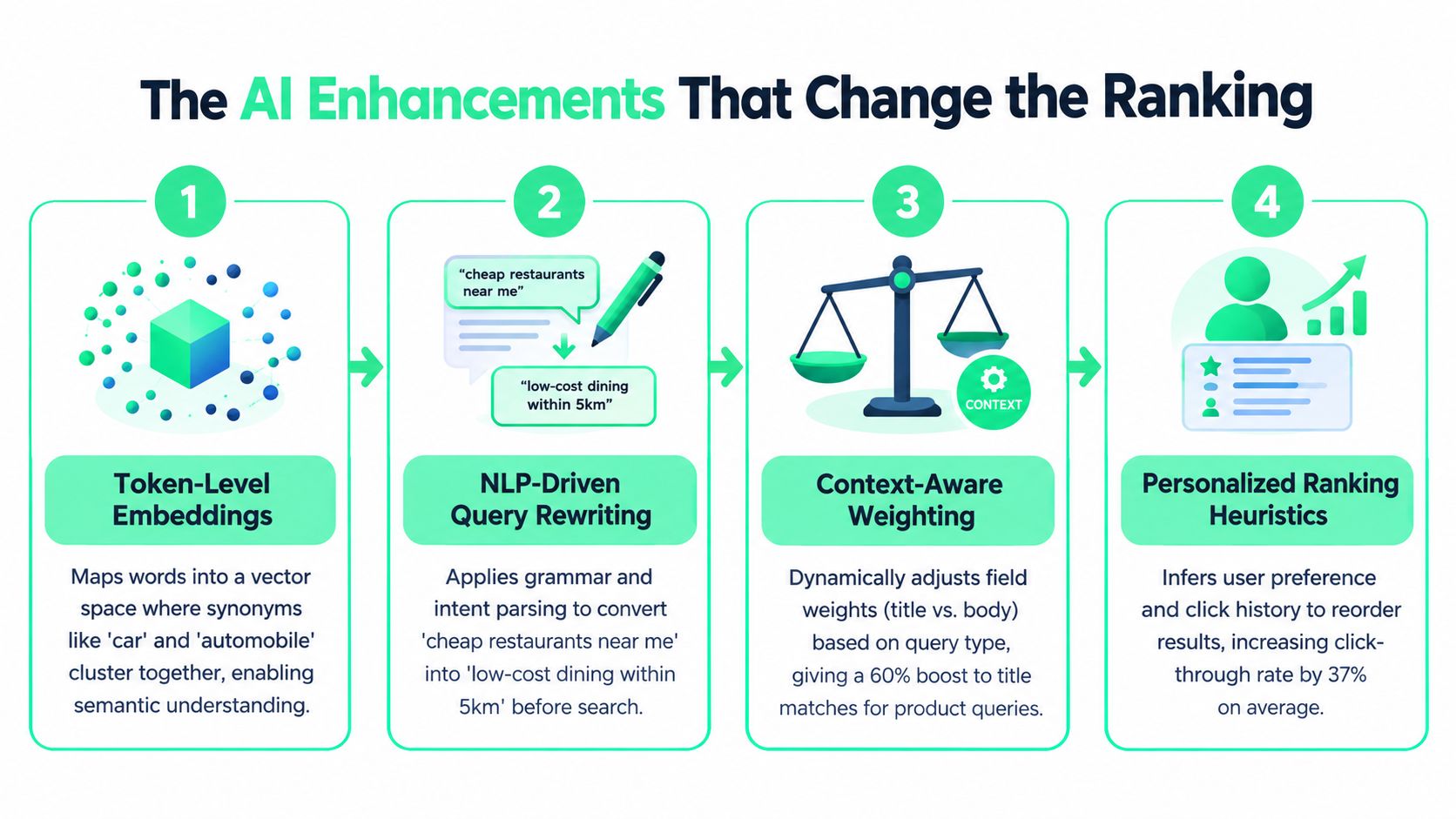
The ranking layer becomes useful when it handles language that literal matching can't connect. A resume may say “data visualization,” while a job posting asks for “dashboard development.” A candidate may search for “SWE,” while a company uses “software development engineer.” AI components help connect those expressions, but each component solves a different problem.
An embedding converts text into a numerical representation in which related concepts can occupy nearby positions. Think of it as a librarian who knows that books about backend architecture, distributed systems, and service design may belong in neighboring sections even when their titles don't share the same words.
For job discovery, embeddings can connect “product analyst” with “growth analytics” when the surrounding responsibilities overlap. They can also recognize transferable skills, such as a data engineer's experience with pipelines and a platform role's requirement for data infrastructure.
Embeddings improve discovery, but they aren't a complete filter. A vector match may understand that two jobs are related while missing a strict requirement such as a particular clearance status or work location.
Natural-language processing can expand abbreviations, identify entities, correct spelling, and turn a conversational request into searchable fields. “Remote senior backend roles in Go, no staffing agencies” becomes a role concept, a level constraint, a location preference, a skill, and an exclusion.
A rewrite can improve recall when users phrase the same need in unfamiliar ways. It can also introduce errors if the system expands a term too aggressively, so the rewritten query should remain inspectable or reversible.
A reranker evaluates the strongest candidates after initial retrieval. It may consider title alignment, skill overlap, seniority, location, posting date, and historical interaction signals such as clicks or applications.
The model doesn't need to rescan the entire index. It only reorders the candidate set, which keeps the experience responsive while allowing more detailed comparison than the first retrieval stage.
Two users can submit the same query and reasonably prefer different results. One may prioritize remote work, another may prefer a particular location, and a third may care most about a specific industry. Personalization adjusts ranking using profile and interaction signals, but systems should make those signals understandable and give users control over important constraints.
For a practical example, an AI job search workflow can combine full-description understanding with explicit job criteria. The useful outcome isn't “AI was added.” It's that the system can distinguish a genuine senior backend role from a listing that merely mentions backend systems in passing, then present the strongest matches in an order the candidate can act on.
A search page answers a request when someone submits it. A smart search agent keeps the request alive.
The candidate registers a search such as “remote senior backend engineer, Go or Rust, employer sponsorship required.” The agent stores the Boolean rules and structured filters, monitors selected job boards, applicant-tracking feeds, and company career pages, then evaluates new or changed postings as they appear.

That loop is what turns a search into a standing request. Our walkthrough on setting up job alerts covers the same pattern from the job seeker's side, and job alerts by email covers the delivery and fatigue trade-offs in more depth.
The system can apply Boolean filters before semantic scoring. A role that fails the visa requirement is discarded even if its wording is an excellent semantic match. Among the survivors, embeddings and reranking help recognize that “distributed services engineer” may fit a backend query even when the exact title differs.
A highly capable model can't recover an opportunity the system discovered too late. For competitive roles, freshness, polling reliability, and notification latency may matter more than adding another layer of language modeling. The AI search market analysis describes smart search as a category that has moved beyond experimental interfaces, with AI-mediated discovery increasingly used for research and high-intent tasks.
That doesn't mean every alert should fire immediately. A useful agent still needs deduplication, quality thresholds, and controls that prevent noisy notifications. It should explain why a role matched and let the user adjust the rule that produced an unwanted result.
The architecture makes Boolean logic and semantic ranking complementary. Rules protect precision, semantic retrieval protects recall, and continuous monitoring protects timing. Together, they turn search from a one-time lookup into an ongoing discovery process.
A smarter model isn't automatically a better search tool. If you know an exact job identifier, requisition code, or company page, literal lookup can be faster and more transparent than semantic retrieval. A semantic system may also expand a short term into related concepts that create noise around a signal the user already knows is exact.
Answer engines introduce a different trade-off. They can provide a direct response without requiring the user to open several result pages. A summary of AI search statistics cites 70% of consumers increasing their use of AI tools for search, while also describing declining trust in AI search. Adoption doesn't remove the need to inspect sources, especially for high-stakes decisions.
Click behavior reinforces the distinction. One report cited 69% zero-click behavior in 2025, and another reported that clicks can fall from 15% to 8% of visits when AI summaries appear, as described in enterprise search survey findings. A direct answer may be convenient, but it isn't necessarily the right interface for discovering a job that requires a verified posting, a source page, and an immediate application.
| Tool Type | Best For | Precision | Recall | Freshness |
|---|---|---|---|---|
| Exact keyword lookup | Known identifiers and exact titles | Strong for literal matches | Limited to expressed terms | Depends on the index |
| Boolean filters | Non-negotiable requirements | Strong when fields are reliable | Can exclude borderline matches | Good when metadata is current |
| Semantic search | Ambiguous discovery and varied wording | Variable without constraints | Broad across related language | Depends on indexing and ranking |
| Answer engine | Direct explanations and summaries | Useful for conversational answers | Not designed for exhaustive listings | Depends on source retrieval |
| Freshness-first alert | Newly published opportunities | Strong when filters are strict | Depends on monitored sources | Prioritizes new information |
Use LinkedIn job alerts or a similar basic alert when the only requirement is a narrow title and immediate notification. Choose smart search when the request is ambiguous, spans several equivalent titles, or needs contextual ranking. Choose exact lookup when a literal identifier is the source of truth.
The decision rule is practical: use semantic expansion for discovery, Boolean logic for boundaries, and simple lookup for known exact targets.
Benchmarks show why semantic matching has become important in resume and job retrieval. A comparative semantic-ranking paper reported up to 92% accuracy in distinguishing and ranking candidates, and a resume-screening study using more than 2,400 resumes reported a 26% improvement in retrieval precision over traditional baselines, as summarized by semantic search and resume-matching research.
The same research summary reports a transformer-based model with 89.47% accuracy, 88.63% recall, and an F1 score of 89.04%. These figures describe evaluated models and tasks, not a guarantee that every production search product will achieve the same results.
| Metric | Keyword Matching | Semantic Matching | Job-Search Implication |
|---|---|---|---|
| Literal title match | Strong | Can be strong, but may generalize | Exact titles remain easy to retrieve lexically |
| Synonym handling | Limited without dictionaries | Stronger because meaning is represented | Related titles and skills are less likely to be missed |
| Accuracy in cited evaluation | Traditional baseline | Up to 92% in one comparative study | More relevant candidate ordering in that evaluation |
| Retrieval precision | Lower than the cited baseline | 26% improvement in one resume-screening study | Fewer irrelevant profiles in a screening queue |
| Transformer evaluation | Not applicable to the cited model | 89.47% accuracy, 88.63% recall, 89.04% F1 | Better balance between relevant and missed matches in that test |
| Freshness sensitivity | Easy to combine with dates | Requires explicit freshness features | Neither method guarantees current postings |
| Short identifiers | Often effective | Can be weak without context | Product names, requisition codes, and names may favor keywords |
Recall affects whether a candidate sees a less obvious role at all. Precision affects whether the candidate can trust the top of the list enough to act without reviewing a large volume of irrelevant postings. Accuracy is useful in evaluation, but production quality also depends on indexing, filters, source coverage, freshness, and the consequences of false positives.
A benchmark winner can still lose in production if its index is stale or its semantic expansion ignores a hard constraint. The strongest design is usually hybrid, with each retrieval method responsible for the failure modes it handles best.
It is search that reads the request as concepts rather than a string of words. It works out what you mean, enforces your hard requirements as filters, compares related wording, and then ranks what is left. In job search that means a query for a senior analytics role can surface a posting titled business intelligence lead, while still respecting a location or work-authorization requirement you set.
Keyword search matches the words you typed and scores documents by where and how often those words appear. Smart search keeps that literal matching and adds two things: semantic retrieval, which connects related meanings, and a ranking layer that reorders results using context, job attributes, freshness, and past behavior. The strongest systems use both rather than replacing one with the other.
No. Boolean logic and structured filters define which postings are eligible, and semantic ranking decides which of those deserve your attention. A model should never rescue a role that fails a hard requirement such as location, visa sponsorship, or seniority. Put anything non-negotiable in a filter, not in a natural-language hint.
Usually because one stage of the pipeline is misbehaving. Too few results points to parsing or over-tight filters. Too many loose matches points to weak Boolean constraints or aggressive semantic expansion. Good matches buried low points to ranking. Stale roles at the top means freshness is not weighted enough. When you know an exact title or requisition code, plain literal lookup is still the better tool.
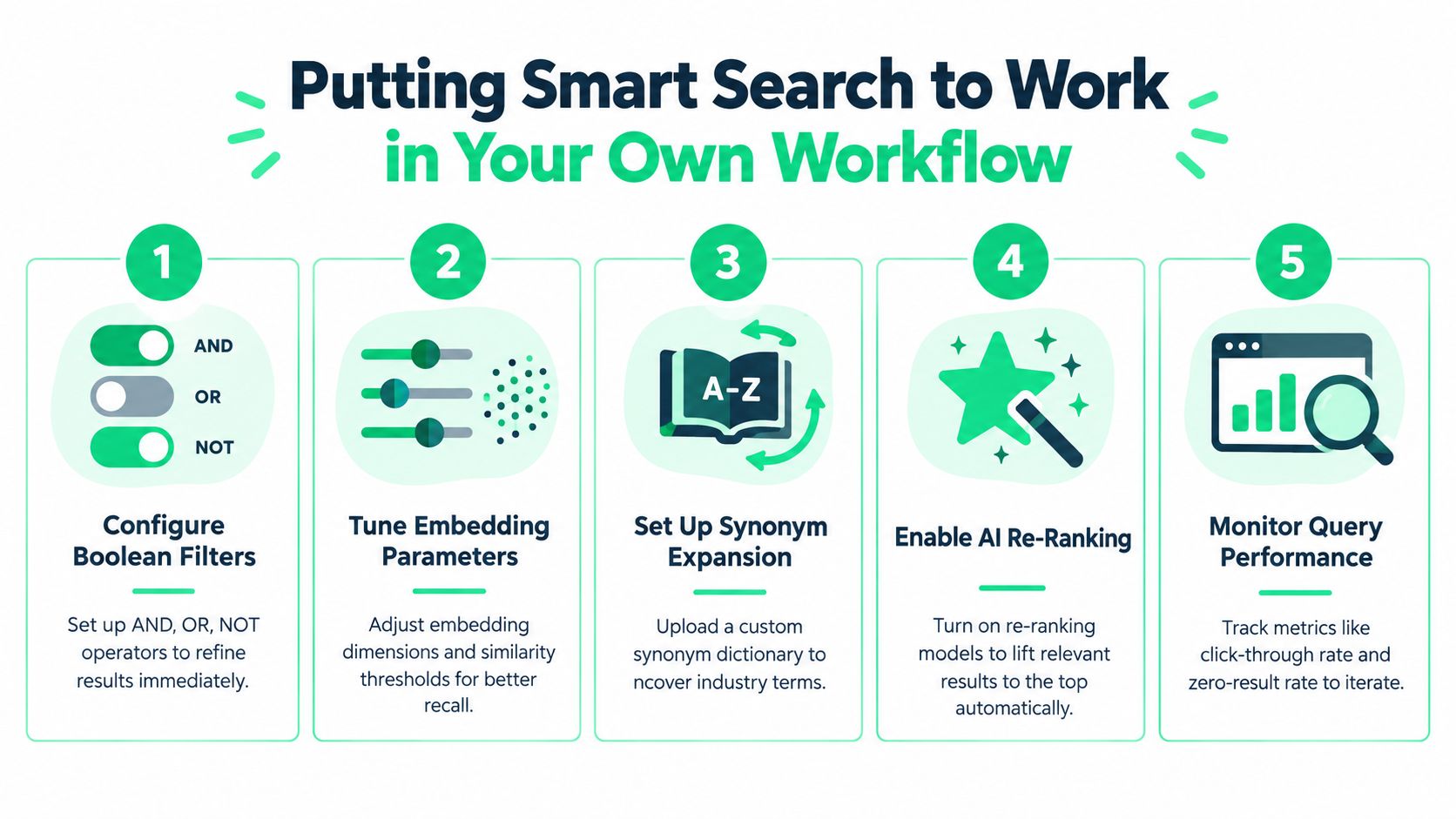
Start with the job-search intent, not the model. Decide whether the query is for discovery, a known role, or an ongoing alert. Then separate must-have constraints from preferences. “Remote” and “eligible to work in a region” may be hard filters, while a preferred industry can influence ranking.
Set Boolean rules first. Use AND for required skills, OR for equivalent technologies, NOT for unwanted levels or domains, and exact phrases for titles that must remain together. Add structured filters for location, remote status, posting date, compensation, and other fields the system can verify.
Tune semantic retrieval next. Review synonym dictionaries and industry terminology, then adjust similarity thresholds carefully. A threshold that is too strict can hide related roles, while one that is too loose can fill the result set with jobs that share a broad theme but miss the actual requirement.
Set freshness behavior separately from relevance. For alerts, define how newly posted or changed roles should be prioritized, how duplicates should be handled, and when an old posting should stop generating notifications.
A useful pre-flight checklist includes:
For candidates, a tool such as FindMeJobs' resume builder can sit after retrieval. The search system identifies a suitable posting, then resume tooling can help align the document's language and evidence with that specific description. Keep that step selective. A model should propose edits, while the candidate decides whether each statement is accurate.
Smart search is moving toward agentic retrieval, where systems monitor sources and act on changes instead of waiting for repeated queries. On-device embeddings may reduce dependence on remote processing for some workflows, while vertical systems for jobs, research, commerce, and support can use domain-specific fields and terminology. The practical direction is clear, but reliable systems will still need source transparency, freshness checks, hard filters, and human review.
Start by testing one real search with five known-good results and five known-bad results. Add the Boolean boundaries, inspect the semantic matches, measure how quickly new postings appear, and only then enable automated alerts.
FindMeJobs runs this pattern for you. You describe the role once with titles, locations, companies, keywords, and Boolean rules, and matching openings reach you while they are still fresh. Visit FindMeJobs to set up a search agent and use its AI-assisted resume tools to adapt your application to each posting. It starts with a 7 day free trial, no card required.
Ten job search automation tools compared on alerts, resume tailoring, autofill, tracking, and auto-apply, so you can fix the bottleneck you actually have.

Job alert emails arrive late or get buried. Fix your filters, inbox rules, and delivery speed so the right roles reach you while they're still fresh.
Learn how to set up automated job alerts that watch for new LinkedIn postings 24/7 and deliver matches to Telegram within minutes. Step-by-step guide with tips.